Hand-painted silk earns its place in haute couture through a five-stage process—fabric preparation, design and resist application, dye application, steam-setting, and finishing—that turns a length of plain silk into a one-of-a-kind artwork. The craft's defining techniques, the Serti resist method and direct paint-on painting, produce effects no printed textile can replicate, and its demands of time, hand skill, and fine materials mirror the very principles that govern couture itself.
The Art of Hand-Painted Silk in Haute Couture
Haute couture is not a loose synonym for luxury fashion. As a fashion industry explainer from Photogenics Media describes, the term is legally protected in France and reserved for fashion houses that meet strict criteria set by the Chambre de Commerce et d'Industrie de Paris. What lies behind that protection is a set of commitments: pieces are created specifically for individual clients, each garment is tailored to the client's measurements and preferences, and the finest fabrics—often sourced from around the world—are worked by hand.
Hand-painting on silk fits this world naturally. Silk artist Polgani Studio, describing its own working method, notes that each painting is drawn and painted one at a time, "so no two items are identical." That individuality is precisely what couture clients pay for: a garment that cannot, by its method of manufacture, be duplicated. Where ready-to-wear is mass-produced in standard sizes, couture is custom-made, often as single pieces—an exclusivity that hand-painted textiles reinforce at the level of the fabric itself.
The Hand-Painted Silk Couture Workflow
The process below sequences the stages a silk textile passes through before it can become part of a garment. It follows the artist's methodology described by Polgani Studio, which paints on silk for wearable pieces; individual couture houses may adapt or vary the workflow, so this sequence should be read as a representative craft method rather than a universal house standard.
| Stage | What happens | Technique and purpose | Couture alignment |
|---|---|---|---|
| 1. Fabric preparation | Each silk piece is pre-washed, ironed, and stretched on a stretcher frame. | Cleaning and tensioning create a smooth, stable surface for precise dye work. | Meticulous hand preparation of fine materials before any design work begins. |
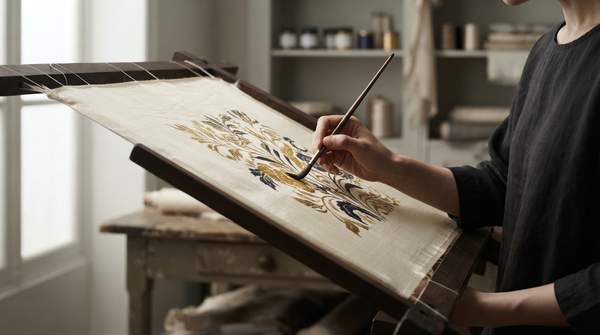
| 2. Design and resist application | The design is drawn with a gutta resist or a special outliner. | In the Serti technique, dried gutta acts as a barrier that keeps dye within outlined areas. | An original, hand-drawn design unique to the piece. |
| 3. Dye application | Dyes are applied with brushes, using watercolor techniques such as wet-on-wet and wet-on-dry, salt, and alcohol effects. | Color is laid either within resist lines or directly onto the silk for blended effects. | Direct artistic expression by hand, with no mechanical printing. |
| 4. Color setting | The dried silk is steamed in a silk steamer for four hours. | Steaming increases color brilliance and bonds the dye to the silk on a molecular level, making it colorfast and washable. | Permanence and durability—quality that survives wear and care. |
| 5. Finishing | The silk is washed again to remove excess dye and gutta, then ironed. | Restores smoothness and luster, preparing the fabric for garment construction. | Final hand finishing before the textile enters the atelier. |
Read as a whole, the workflow shows why the craft is valued: every stage depends on the maker's hands and judgment, and the four-hour steam-setting step is what transforms a delicate surface decoration into a permanent, wearable artwork. The artist's own summary is telling—"painting on silk might be a long process, but well worth the result."
Primary Techniques: Serti (Resist) vs. Direct Paint-On
The two principal methods described in the evidence produce distinctly different visual characters. The Serti technique—Polgani Studio translates the French as "closing" or "fence"—begins with a design drawn in gutta resist or a special outliner. Once the gutta has dried, it acts as a barrier for the dye, keeping color within the outlined areas of the design. The result is controlled, defined color fields with crisp boundaries, an effect often compared to stained glass.
The direct paint-on method works differently. Here dyes are applied straight onto the silk using an array of watercolor techniques: wet-on-wet and wet-on-dry painting, salt, and alcohol effects. Because dye spreads quickly on silk, the method demands control even as it invites fluid, blended expression—and, as the studio notes, the effects on silk are often more dramatic than the same techniques produce on paper. In couture terms, the choice between the two is a choice between graphic definition and painterly diffusion: Serti for structured, architectural pattern; direct painting for gradients and atmospheric color.
Hand-Painted Silk: Embodying Haute Couture Principles
Each of couture's defining characteristics finds a concrete counterpart in this craft. Customization: because every painting is drawn and painted individually, a hand-painted silk panel can be designed around a single client's garment and figure, echoing the Photogenics Media explainer's point that couture pieces are created specifically for individual clients with, in its words, "an unmatched level of personalization and attention to detail."
Artistry: the direct paint-on method's watercolor vocabulary makes the fabric itself a painting, and the Serti technique makes it a drawn and composed design—both are individualized, artistic processes rather than commercialized ones. Craftsmanship: the five-stage workflow, from pre-washing through a four-hour steam setting, is intensive handwork at every step, the same category of skilled labor that makes couture, in the explainer's comparison table, extremely high in cost "due to craftsmanship" and exclusive in availability. Materials: Polgani Studio paints only on 100% silk fabrics—Habotai, the classic painting silk with a subtle sheen; Crepe de Chine, with its crinkled texture and graceful drape; and Flat Crepe, lighter and shinier—using special silk dyes imported from Europe. That insistence on superior fabric aligns directly with couture's demand for the finest materials, chosen for both beauty and durability.
One caveat deserves emphasis: the process described here is a general artist's methodology, and couture houses may vary it. What the synthesis supports is not that every atelier paints silk this way, but that when a house does employ hand-painting, the technique delivers exactly what couture promises—uniqueness, hand skill, and material quality in a single textile.
Appreciating the Value of Hand-Painted Silk in Haute Couture
Discerning fashion enthusiasts should recognize hand-painted silk as a pinnacle of haute couture artistry, valuing garments that showcase its intricate techniques and personalized expression. The craft's value is not decorative mystique: it is the demonstrable labor of a five-stage process, the permanence conferred by molecular-level steam setting, and the impossibility of two identical pieces.
The measurable indicator is visible in the garment itself: the presence of unique, non-repeating patterns, subtle brushstroke variations, and the luxurious feel of high-quality silk, often accompanied by designer attribution for the hand-painting process. A printed silk can repeat; a hand-painted one cannot. When those signs appear together in a couture piece, the wearer is looking at fabric that passed through an artist's hands—washed, stretched, drawn, painted, steamed for four hours, and finished one piece at a time.