Luxury home automation is not defined by how many smart devices a house contains. According to the home technology specialists at Boca Tech and Automation, true luxury automation transforms a residence into an intuitive, seamless environment where every system works harmoniously, going beyond simple app controls or voice-activated gadgets. The practical test for a homeowner evaluating any proposal: does the system deliver unified control, context-aware automation, and future-proof design, or is it merely a collection of disconnected products? This article offers a three-dimension framework for making that judgment.
Defining Luxury Smart Home Integration: Beyond Basic Automation
Entry-level "smart home" products typically suggest mass-market solutions, in the words of Boca Tech and Automation, whereas luxury integration weaves advanced technology into the very fabric of the home. The distinction matters because a room full of capable devices can still feel disjointed. Writing on high-end design strategies, David Waechter of Hibriten Homes describes the goal as an intelligent ecosystem where automation adapts to behavior, location, and device status rather than simply responding to a command.
Coverage of the ultra-luxury real estate market by MILLION reaches the same conclusion from the buyer's side: in the most sophisticated estates, "integration matters more than gadget count, and invisible performance matters more than headline features." The benchmark residence is one in which lighting, climate, security, entertainment, and access operate as one coherent digital architecture. That coherence—not any individual feature—is what a homeowner should be paying for.
Evaluating Luxury Smart Home Integration: A Decision Framework
Use the diagnostic table below to place a proposed system along a spectrum from basic automation to true luxury integration. Read each row's basic-automation symptom, then ask the installer to demonstrate the luxury-integration counterpart. A system that satisfies most rows on the luxury side qualifies as a unified ecosystem; one that fails the integration and intelligence rows in particular is best understood as a collection of gadgets.
| Characteristic | Dimension | Basic Automation | True Luxury Integration |
|---|---|---|---|
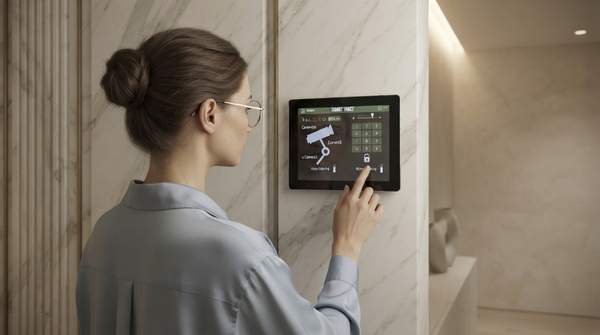
| System control | Integration level | Multiple apps, one device per function | A single interface across lighting, climate, security, entertainment, and access |
| Automation intelligence | Behavioral adaptation | Manual commands and simple timers | Automation that adapts to behavior, location, and device status with personalized responses |
| Security posture | Intelligence | Basic monitoring and alerts | Systems that continuously assess risk and proactively manage access from real-time data |
| Scalability and aesthetics | Future-proofing | Fixed configuration; visible hardware accumulates | An adaptable system that grows with new technology while staying visually discreet |
| Interoperability | Long-term viability | Proprietary devices that fragment the ecosystem | Compliance with universal protocols such as Matter or Zigbee for cross-brand compatibility |
The reasoning behind each row is consistent across the sources. Unified control is singled out by Xtend Technologies as "one of the most important aspects of a luxury smart home," while Hibriten Homes ties interoperability standards directly to avoiding fragmentation. A proposal that cannot demonstrate a given row should be treated as a gap to close, not a detail to defer.