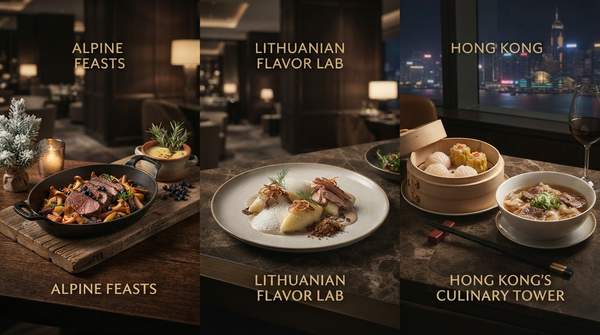
Luxury hotel dining has quietly outgrown the era when a Michelin star was enough. Today's most compelling properties build their gastronomic identity around a concept—a defining philosophy that shapes where you eat, what you eat, and why it could only happen in that place. Three hotels illustrate the range of approaches particularly well: Rote Wand in Austria, which carries its feasts into high Alpine meadows; Hotel Pacai in Vilnius, whose Michelin-starred kitchen excavates the genuine flavors of Lithuania; and the Four Seasons Hotel Hong Kong, which assembles an entire constellation of high-end restaurants under one roof.
Beyond Michelin: The New Era of Luxury Hotel Dining
Award directories and star ratings still matter, but they no longer tell the whole story of why a hotel becomes a food destination. As travel coverage of food-focused hotels has noted, the defining quality of the most distinctive programs is no longer technical excellence alone—it is a clearly articulated idea. That idea can take three very different forms: an immersive natural setting that dissolves the boundary between restaurant and landscape; a hyper-local sourcing philosophy that makes regional ingredients the entire point of the menu; or sheer breadth, where one hotel concentrates several world-class dining concepts in a single address. Each of the three hotels below exemplifies one of these strategies, and understanding which type appeals to you is the fastest way to choose a destination that matches your gastronomic interests.