The edge of a leather product is where craftsmanship is most visible and where failure most often begins. Three techniques dominate high-quality goods: burnishing, painting, and turning. Each is tied to a particular kind of leather, each carries a distinct aesthetic, and each fails in its own characteristic way. Understanding these differences lets you judge a piece before you buy it.
The Art of Leather Edge Finishing: An Introduction
Edge finishing is the treatment applied to the cut boundary of the leather, where the material's fibrous interior is exposed. According to Rick Burns-Howell, writing for the British leather goods maker Tanner Bates, the choice of edge treatment depends on a chain of considerations: the type of leather, the type of product, production time, and aesthetics. Most of that maker's products carry a finished cut edge, described as the most traditional and most durable method.
The critical variable is tannage. Vegetable-tanned (or bark-tanned) leather can be burnished; chrome-tanned leather cannot, and its edges must instead be hidden by turning or covered with edge paint. This single fact explains most of what you see on finished goods: a burnished edge signals a vegetable-tanned hide and a labor-intensive hand process, while a painted edge usually indicates chrome-tanned leather. Turned edges occupy a third category, folding the leather over itself to conceal the cut entirely.
Burnished Edges: Traditional Durability
Burnishing is a polishing process that compresses and smooths the exposed fibers of the cut edge, producing a slick, often shiny surface. As described by Tanner Bates, it is done with a burnishing tool and a lubricant—water, gum tragacanth, tokonole, or beeswax. The edge may also be dyed, using special edge dyes or regular leather dyes applied with a wool dauber, to match or contrast with the body of the piece.
The technique is demanding. Hand burnishing is, in Tanner Bates' words, time-consuming and labour-intensive, though it can achieve an incredible aesthetic. Preparation matters as much as the final polish: edges are typically beveled—rounded with a tool or, for very fine work, a skiving knife—and further smoothed with sandpaper before the burnishing tool ever touches them. Done well, the result is a dense, sealed edge that resists wear and moisture, and occasional re-burnishing can restore its shine after use. The prerequisite is a quality, naturally vegetable-tanned leather whose fibers will compress and hold the polished state.
Painted Edges: Modern Aesthetics and Common Wear
Painted edges are built up in multiple layers of specialized paint applied to the cut edge, and Tanner Bates notes they are a popular option among many luxury brands. Their rise is largely a consequence of material economics: chrome-tanned leathers, which dominate modern production, cannot be burnished, so paint becomes the only way to finish their edges cleanly.
The durability of a painted edge depends heavily on layer count and drying discipline. Writing for Bagsplaza, Mandy Chou describes a production case in which a standard protocol of four layers with 45-minute drying intervals was cut to two layers with 30-minute intervals to meet a compressed 15-day delivery on a tote bag reorder. Final inspection showed smooth edges, but the buyer reported cracking complaints three weeks after delivery. Thin single-layer paint, she explains, looks acceptable at inspection because surface smoothness appears similar, but cracks faster under flexing stress than multi-layer applications.
Environmental exposure compounds the risk. A bag-care specialist at Dr Bags reports that prolonged exposure to heat or direct sunlight dries out both the leather and the painted edge, making the paint brittle and more prone to cracking—even strong sunlight through indoor windows can gradually weaken the finish. The lesson for a buyer: a painted edge is not inherently inferior, but its quality is invisible at the surface and reveals itself only over weeks and months of use.
Turned Edges: Seamless Elegance
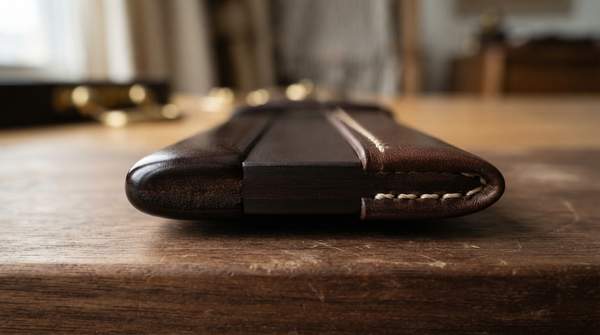
The turned edge conceals the cut boundary entirely. As Tanner Bates explains, the leather must first be thinned down to a wafer-thin sliver, which is then turned over to hide the cut edge and stitched in place. The result is a clean, seamless line with no visible raw fiber at all—an aesthetic suited to fine, delicate work.
The trade-off is structural. Because the leather at the fold is so thin, the edge can wear through and break over time. This makes the turned edge the most elegant but generally the most vulnerable of the three finishes, a choice that prioritizes appearance over maximum durability. On a delicate item handled gently, that trade may be entirely reasonable; on a daily-use bag, it is worth knowing what the folded edge will do after years of flexing.
Comparative Guide to Leather Edge Finishing Techniques
The table below compares the three techniques across the criteria that matter when evaluating a finished piece: the leather type each suits, the appearance it produces, and how it behaves over time.
| Technique | Best For (Leather Type) | Aesthetic | Durability / Wear Pattern |
|---|---|---|---|
| Burnished edge | Quality vegetable- (bark-) tanned leather; chrome-tanned leather cannot be burnished | Dense, slick, often shiny polished edge; may be dyed to match or contrast | Most traditional and durable method; resists wear and moisture, and shine can be restored by re-burnishing |
| Painted edge | Chrome-tanned leathers that do not accept burnishing; popular among luxury brands | Clean, finished look; color varies with paint choice | Durable when built in multiple layers with proper drying, but thin applications crack under flexing stress; heat and sunlight make paint brittle and prone to cracking |
| Turned edge | Delicate, fine work where a seamless look is prioritized | Clean, seamless edge with the cut fully concealed and stitched | Leather is thinned to a wafer for turning, so the edge can wear through and break over time |
Read across the rows, the table yields a simple decision logic: the tannage of the leather largely dictates the technique, and the technique dictates the failure mode you should anticipate. A burnished edge rewards vegetable-tanned leather with the longest service life; a painted edge is the necessary solution for chrome-tanned leather, with quality determined by layering discipline; a turned edge buys elegance at the cost of long-term resilience.
Diagnostic Framework: Assessing Leather Edge Quality
Once you can name the technique, evaluating its execution is a matter of visual inspection. The following checklist draws on the process descriptions above—each cue corresponds to a step a careful maker either performed or skipped. This is a non-destructive assessment suitable for a shop or a pre-owned purchase; it does not require testing the edge to failure.
- Identify the technique first. A polished, glossy edge on vegetable-tanned leather is burnished; a coated, uniform-color edge on chrome-tanned leather is painted; a folded-and-stitched edge with no visible cut is turned.
- Check for smoothness and lack of fibers. A quality burnished edge should be slick and shiny, with no loose fibers or rough patches—evidence that beveling, sanding, and polishing were all completed.
- Check for consistent color and application. On painted or dyed edges, look for even coverage with no thin spots, drips, or color variation along the length of the edge.
- Check for a sealed, non-porous surface. The edge should appear dense and closed, not dry or chalky, indicating the fibers have been properly compressed or coated.
- Check for cracking or peeling on painted edges. Fine cracks or lifting paint signal thin paint layers or environmental drying—remember that Bagsplaza's reduced-layer example passed final inspection and cracked within three weeks.
- Check turned edges for wear at the fold. Because the leather is thinned to a wafer, look for fraying, thinning, or separation where the folded edge flexes.
Two caveats frame this framework. First, it covers only the three finishes common to high-quality goods; raw or unfinished edges are outside its scope. Second, surface appearance at the point of sale is an imperfect predictor for painted edges specifically—the Bagsplaza case shows that an under-layered edge can look identical to a properly built one until normal use reveals the difference weeks later.
Making an Informed Choice: Assessing Your Leather Goods
When evaluating luxury leather goods, consumers should visually inspect the edges to identify the finishing technique and assess its quality based on the expected characteristics and common failure points for that method. Match the finish to the leather: burnished on vegetable-tanned hides, painted on chrome-tanned leather, turned on delicate pieces where the seamless look justifies the durability trade-off. Then apply the checklist to the specific edge in front of you.
The measurable indicator is straightforward: the presence of a smooth, consistent, and unblemished edge finish, free from fraying, cracking, or peeling, indicates high-quality craftsmanship. An edge that passes that test on the shelf—and shows no cracking or peeling after weeks of flexing in the case of painted finishes—has demonstrated the durability its technique promises.