True luxury in leather goods is not a label but a construction method, and two areas reveal it most clearly: the edges and the seams. Edge finishing—beveling sharp contours and burnishing them smooth, often with wax or layered dye—seals the leather against moisture and wear, while the hand-sewn saddle stitch, in which each stitch is individually secured, produces a seam that holds even if a thread breaks. These are the observable markers that separate artisanal work from mass production, and understanding why they work is the key to judging quality with confidence.
The Foundation of Luxury: Premium Leather Selection
Before any stitch is placed or edge polished, the potential of a luxury leather piece is set by its raw material. Craft-focused accounts of high-end bag making place the selection of leather at the very heart of the process: the leather, chosen with the utmost care, is described as the centrepiece that gives a bag both its elegance and its longevity. In this framing, the artisan's skill can only be applied to a canvas worthy of it.
This is why material selection is a crucial initial step that dictates the potential of the final product. A flawless hide allows the bevel to cut cleanly, the burnishing tool to glide, and the waxed thread to seat evenly. Conversely, no amount of finishing can fully compensate for inferior leather, because the edges and seams depend on the material's density and consistency to hold their form. Writers on handmade leatherwork echo the point, describing luxury goods that "last a lifetime" as the product of traditional technique applied to high-quality material at every step.
Precision at the Edges: Beveling and Burnishing
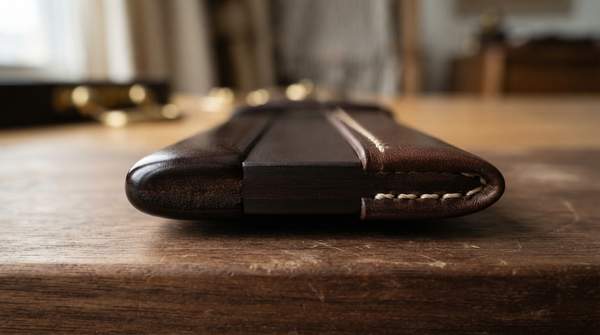
Edge finishing is, in the words of one leather-craft tutorial, "one of the defining features that separates amateur leather goods from luxury craftsmanship." The process begins with beveling, which trims the sharp, square edges of cut leather into a softened profile. Burnishing then follows: the artisan rubs the beveled edge with a tool, often with wax, until the fibers compress into a smooth, glossy surface.
Descriptions of luxury bag construction add that this work is often carried out by hand, involving multiple layers of specialized dye applied before the contours are gently polished to a soft touch and a seamless finish. The process requires meticulous attention to detail and multiple layers—rushing it shows immediately in the result.
The payoff is both functional and aesthetic. Functionally, a properly sealed edge resists moisture penetration and prevents fraying, which is why the edge is a critical technical element for durability: it is where cut fibers are most exposed to water, abrasion, and splitting. Aesthetically, the finished edge reads as a single, continuous line around the piece—a refinement that luxury is defined by, in the perfection of every finish.
The Strength of the Seam: Hand-Stitching and the Saddle Stitch
While machines offer speed, hand-stitching remains, as one craft practitioner puts it, "the gold standard for durable leatherwork." Its centerpiece is the saddle stitch, a centuries-old technique still practiced by luxury houses today. The sewer works with two needles and a single strand of waxed thread, passing each needle through the same hole from opposite sides so that every stitch is individually secured within the seam.
That construction explains the technique's celebrated durability. Because each stitch is independently knotted and locked, a break in the thread does not cascade: the seam retains its integrity rather than unraveling along its length. This stands in contrast to the machine lockstitch, in which a single broken thread can allow the whole seam to progressively come undone. The individual knotting of each stitch is key to its integrity.
The saddle stitch also carries a visible signature. Its slightly angled, uniform stitches create a distinct artisanal finish of remarkable elegance—one reason it is considered a true hallmark of luxury leather goods. Instruction in artisanal leatherwork treats it accordingly: courses on the craft teach saddle stitching alongside waxing thread, punching holes, and multiple edge-painting techniques as the core skills of professional-quality finishing.
Craftsmanship Unveiled: Techniques and Their Impact
The techniques above work as a system: material, edge, and seam each convert an artisanal action into a specific, observable result. The framework below maps that cause-and-effect relationship, so a reader can locate the two key areas of construction on any leather good and trace how the technique used directly produces its qualities of luxury and durability.
| Area | Technique and process | Functional benefit | Aesthetic benefit |
|---|---|---|---|
| Material | Meticulous selection of high-quality leather as the foundational step | Dictates the potential of the final product; supports clean edges and stable seams | Confers the elegance and longevity associated with luxury |
| Edge finishing | Beveling trims sharp edges; burnishing rubs them with tools and wax; hand-applied layers of dye are polished to a soft touch | Sealed edges resist moisture penetration and prevent fraying, extending durability | A smooth, seamless, polished contour—a hallmark of high craftsmanship |
| Seam construction | Saddle stitch: two needles, one waxed thread, each stitch individually knotted | Seam will not unravel if a single thread breaks, unlike a machine lockstitch | Distinct, slightly angled, uniform stitches of remarkable artisanal elegance |
Read as a whole, the framework shows that luxury is cumulative: the hide sets the ceiling, the edge protects and refines, and the seam guarantees the piece holds together through decades of use.
Identifying True Craftsmanship: What to Look For
These techniques translate into a short inspection routine. At the edges, run a finger along the contour: a hand-finished edge should feel smooth and sealed, with no fraying fibers, peeling dye, or raw cut lines visible. Glossiness from burnishing, rather than a rough or painted-over edge, signals that the fibers were compressed and sealed rather than merely coated.
At the seams, examine the stitch pattern. A saddle stitch shows uniform, slightly angled stitches that appear individually secured, and the thread—typically waxed—should sit snugly in its holes without looseness. Machine lockstitching, by contrast, tends toward a flatter, more uniform appearance and carries the structural vulnerability described above: one broken thread can compromise the seam. Where both the edge and the seam pass inspection, the two most failure-prone zones of a leather good have been verified.
Making an Informed Choice: Recognizing Luxury Leather
When evaluating luxury leather goods, prioritize items that demonstrate meticulous hand-finished edges and hand-stitched seams, particularly saddle stitching. Writers on the craft are consistent on this point: prestige lies in the artisan's skill and the rigorous selection of materials, with precision taking precedence over brand appeal—an elegance that stands the test of time.
The judgment can be made concrete before purchase. Look for smooth, sealed edges without fraying or peeling, and uniform, slightly angled stitches that appear individually secured, indicating a saddle stitch. An item that passes both checks shows the two construction details most responsible for longevity; one that fails them, whatever its price or label, lacks the technical foundation that defines genuine artisanal quality.
Sources
- Specialization in Artisanal Leather Crafting Techniques - Online Course — Domestika
- The Art of handmade leather craftsmanship: A Journey of Craftsmanship — Old Town Leather Goods
- The crafting secrets behind a luxury leather bag - Duret Paris
- 5 Fundamental Leather Craftsmanship Techniques for Premium-Quality Creations — TXTURE Boots