The three most celebrated luxury watch complications — the tourbillon, the perpetual calendar, and the chronograph — are prized not simply for what they do, but for the distinct engineering problems they solve. The tourbillon attacks gravity's pull on a movement's accuracy; the perpetual calendar compresses the irregularities of the calendar year into a miniature mechanical memory; the chronograph layers an on-demand stopwatch onto a running timekeeper. Understanding which problem each one addresses is the clearest way to understand why they command such prestige and price.
Introduction to Watch Complications
In horology, a complication is any function a watch performs beyond simple time display. The term covers an enormous range: self-winding mechanisms, power reserve indicators, moon phases, alarms, and GMT displays all qualify. What makes complications remarkable, as the horological reference literature notes, is that they appear most notably in mechanical watches, where the small size of the movement makes them difficult to design and assemble.
The scale of that difficulty is concrete. A typical date-display chronograph may contain up to 250 parts, while a particularly complex watch can carry a thousand or more. Watches combining several complications are known as grandes complications, and ultra-complicated pieces are produced in strictly limited numbers — some as unique instruments — by houses such as Breguet, Patek Philippe, and Vacheron Constantin.
The Tourbillon: Mastering Gravity for Precision
Patented by Abraham-Louis Breguet in 1801, the tourbillon — French for "whirlwind" — was designed to compensate for the ill effects of gravitational pull on a watch movement's accuracy. It does so by placing the balance and escapement inside a rotating cage that makes a full 360-degree revolution every minute, averaging out positional errors rather than eliminating them entirely.
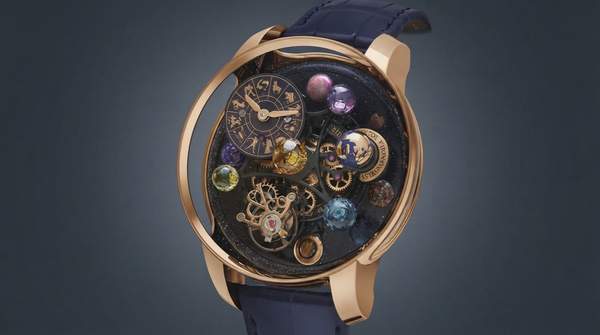
Strictly speaking, as watch writer Mark Bernardo observes, the tourbillon is not even a complication in the narrowest sense, because it adds no additional function to timekeeping. Yet it is held up as an example of elite horological technology, and watches equipped with them are highly prized and almost invariably pricey. The difficulty lies in the small size and intricate assembly required to keep a rotating cage in constant, precise motion — and in the visual spectacle of watching it turn.
The Perpetual Calendar: Astronomical Tracking in Miniature
A perpetual calendar accurately displays the date, day, month, and leap-year indication, requiring no manual adjustment until the year 2100 in standard formulations. The mechanical challenge is programming a watch to correctly handle variable month lengths — 28, 29, 30, and 31 days — and to adjust automatically for leap years, all within a wrist-sized case.
Watches of Switzerland's Calibre guide describes the perpetual calendar as the height of haute horlogerie, owing to the hundreds of extra gears required for it to function, and notes that the complexity makes the complication a rarity that is often reflected in its price point. Its prestige stems from that blend of genuine utility and extreme mechanical sophistication: it is a working calendar, not merely a display of craft.
The Chronograph: Utility and Measurement
The chronograph is the most practical of the three: a stopwatch function that measures elapsed time independently of the main time display, with start, stop, and reset operations. As a category of watch, it is used as a stopwatch as well as for telling the time, and it ranks second only to the GMT complication in everyday usefulness, according to collector-facing guides — valuable for timing any event.
Its complexity is of a different character from the other two. Rather than tracking celestial cycles or neutralizing gravity, the chronograph's challenge is precise control: integrating an on-demand timing mechanism with the running movement so that engaging, halting, and resetting the seconds does not disturb the timekeeping beneath it. A date-display chronograph may require up to 250 parts to achieve this coordination.
Comparing Iconic Watch Complications
Set side by side, the three complications reveal a framework for reading any complicated watch: identify the engineering problem, and the prestige follows. The table below categorizes each by its primary function, the core mechanical challenge it solves, and its standing in the hierarchy of watchmaking.
| Complication | Primary Function | ||
|---|---|---|---|
| Tourbillon | Rotates the balance and escapement in a cage making one revolution per minute to counteract gravity's effect on accuracy | Miniaturizing a rotating cage that houses the escapement and moves constantly and precisely; it minimizes gravitational error rather than eliminating it | Widely considered the pinnacle of mechanical watchmaking; historically innovative and visually spectacular |
| Perpetual Calendar | Displays date, day, month, and leap year with no manual adjustment until 2100 | Mechanically programming variable month lengths (28–31 days) and automatic leap-year adjustment, often requiring hundreds of extra gears | Ranked second in prestige; the height of haute horlogerie, blending utility with extreme complexity |
| Chronograph | Stopwatch measurement of elapsed time, independent of the main time display | Integrating precise start, stop, and reset control with the running movement — up to 250 parts in a date-display version | Highly practical rather than purely prestigious; valued for utility and mechanical coordination |
The comparison also clarifies a collector's distinction: tourbillons and perpetual calendars are primarily for collectors and investors, while the chronograph earns its place through everyday usefulness. All three, however, derive their value from the same source — the difficulty of executing complex mechanics at wristwatch scale.
Why Mechanical Complications Endure in the Digital Age
None of these mechanisms outperforms a quartz movement or a phone for accuracy or convenience, which is precisely the point. Their value rests on three pillars that no digital device replicates. The first is artisanal craftsmanship: the hundreds of extra gears in a perpetual calendar, or the hand-finished rotating cage of a tourbillon, represent hours of skilled assembly in miniature.
The second is engineering excellence in miniaturization. The difficulty of designing and assembling complications at movement scale — where a thousand or more parts may coexist in a single case — is the technical achievement collectors are actually paying for. The third is heritage: the tourbillon's story reaches back to Breguet's 1801 patent, and the tradition of uniting many functions in a single timepiece drove the first ultra-complicated pocket watches.
The market reflects this enduring appeal. Complicated watches from established manufacturers consistently outperform simpler models at auction, with Patek Philippe perpetual calendar pieces regularly selling for 150 to 300 percent above retail — and a Patek Philippe Sky Moon Tourbillon, produced at just two pieces per year, having sold for $5.8 million online.
Appreciating Horological Mastery
When evaluating luxury watches, consider the specific engineering problem a complication solves — precision, calendar tracking, or timing — as the key indicator of its mechanical ingenuity and artisanal value. A complication's name tells you little; the problem it was built to overcome tells you everything about why it was difficult to make and why it commands a premium.
The measurable test of that understanding is simple: the ability to articulate the distinct engineering purpose and mechanical challenge behind a tourbillon, perpetual calendar, or chronograph. A reader who can explain why a rotating cage averages positional error, why a calendar needs a mechanical memory for leap years, or why a stopwatch demands seamless coordination with a running movement has grasped not just what these complications are, but why watchmaking still celebrates them.
Sources
- Watch Complications Explained: Chronograph, Tourbillon, GMT... — Luxury Watches USA
- Complication (horology) - Wikipedia — EN
- Watch Complications: A Comprehensive Guide - Teddy Baldassarre
- A Guide To Watch Complications | Calibre — Watches OF Switzerland